Gap Trading
How PipFarm handles profit from large price gaps
Gap trading refers to opening or holding positions that profit from sudden and significant price jumps, known as gaps. A gap occurs when the next available price is significantly higher or lower than the last traded price, without passing through the intervening levels.
While price gaps can happen unpredictably, they also occur at predictable times — such as at market open after a weekend or during high-impact news events. Some traders deliberately target these opportunities, which exploit the simulated trading model.
⚠️ This is a soft breach. You will not be disqualified for encountering a price gap, but a portion of your profit will be deducted.
ℹ️ This rule applies to both challenge and simulated funded accounts.
What is a price gap?
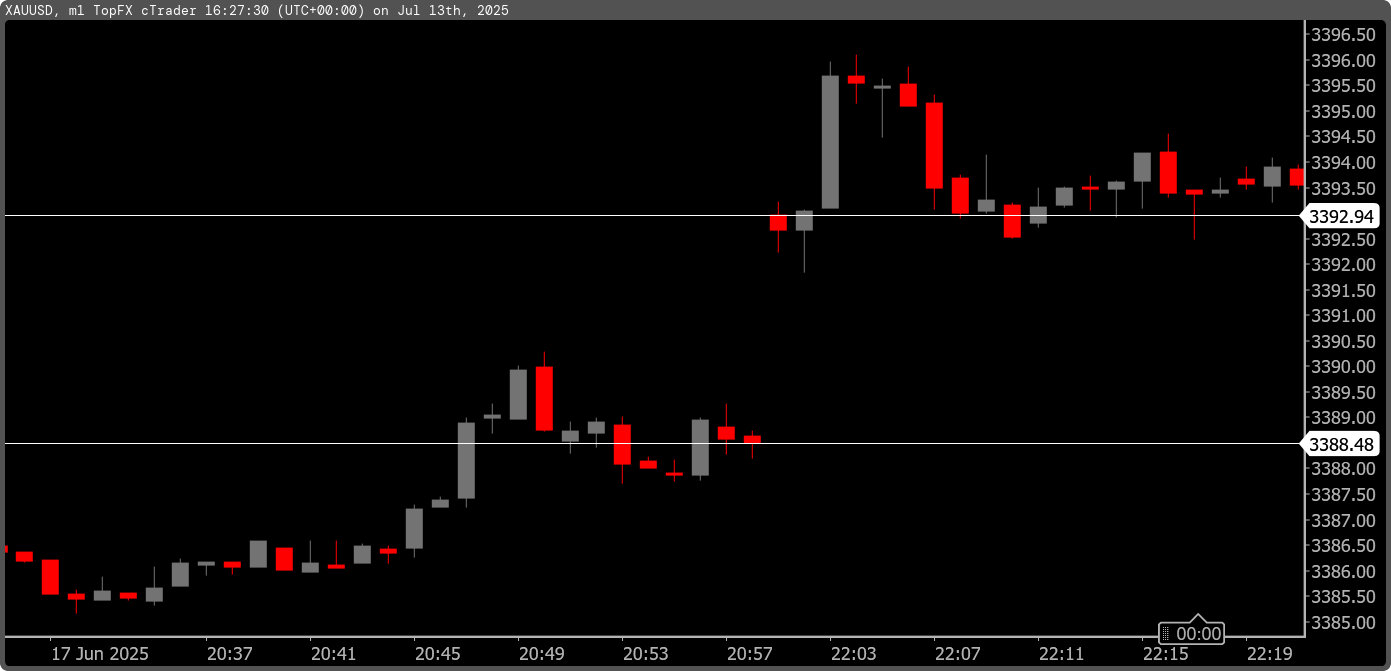
A price gap occurs when the market moves from one price level to another without trading through the prices in between. On a chart, this looks like a sudden jump or drop where candles don't connect smoothly — there is a visible gap between the closing price of one period and the opening price of the next.
The image below shows the gold price jumping from $3,388.48 to $3,392.94, representing a 0.13% gap.
Price gaps can happen:
At the opening of a new session (e.g. after a weekend or daily close)
During high volatility, when the price skips levels due to a lack of liquidity
After unexpected news or headlines
At any time, not just during scheduled events
The gap rule
If your position profits from a gap of 0.2% or more, PipFarm applies a deduction equal to the larger of these two amounts:
Half (50%) of the position's total profit, or
The profit attributable to the gap itself
Whichever figure is larger is deducted from your closed profit. In practice, a qualifying gap will never cost you less than half of that position's profit — and if the gap portion is larger than half, the full gap profit is deducted instead.
⚠️ Gap deductions are applied when your payout request is reviewed. If a deduction leaves you below a payout requirement — such as your Consistency Score, Profitable Days, or Profit Target — the payout cannot be released. You will be asked to continue trading until you meet the requirement again, then submit a new payout request in line with your normal payout interval.
Example 1 — Weekend gap (gap is larger)
Suppose you buy 1 lot of XAU/USD at $3,495 on Friday. The market closes Friday at $3,500, then gaps up over the weekend, reopening Monday at $3,517.50 — a 0.5% gap. You close the position at $3,520.
Example 2 — Small gap, large profit (half is larger)
You buy 1 BTC/USD at $95,000. Over the session, the price rises gradually to $99,000. A sudden gap then occurs — the price jumps from $99,000 to $99,297 (a 0.3% gap) — and you close the position there.
Why this rule exists
This policy protects PipFarm from potentially unlimited losses in a simulated trading environment. Gaps below 0.2% are ignored, but once a gap of 0.2% or more contributes to a winning position, PipFarm deducts the larger of half the position's profit or the gap profit itself.
Frequently asked questions
Does this rule protect me if a gap causes a loss?
Does this rule protect me if a gap causes a loss?
No. This rule is not applied in both directions. If a gap causes a loss on your trade, it still counts as a valid outcome. As a trader, your risk is limited to the price you paid for your challenge. PipFarm, on the other hand, has potentially unlimited exposure in a simulated environment. To keep the program sustainable and fair, this rule only limits profit from gaps — it does not protect against losses caused by them.
Does this rule apply to challenge accounts?
Does this rule apply to challenge accounts?
Yes. The gap trading policy applies to both challenge and simulated funded accounts. Any position that benefits from a gap of 0.2% or larger has a deduction applied — the larger of half the position's profit or the gap profit itself.
Will I be disqualified for encountering a gap?
Will I be disqualified for encountering a gap?
No. This is a soft breach. You will not lose your account for encountering a price gap. The only consequence is the profit deduction described above.
What if I didn't intentionally trade the gap?
What if I didn't intentionally trade the gap?
The rule applies regardless of intent. Gaps can happen at any time, and PipFarm does not distinguish between intentional and unintentional gap profit. Gaps smaller than 0.2% do not trigger a deduction.
What happens if a gap deduction affects my payout?
What happens if a gap deduction affects my payout?
Gap deductions are applied when your payout request is reviewed. If the deduction leaves you below a payout requirement — such as your Consistency Score, Profitable Days, or Profit Target — the payout cannot be released. You will be asked to continue trading until you meet the requirement again, then submit a new payout request in line with your normal payout interval.
Related articles
Was this helpful?